












Click here to subscribe FREE to Ray Hanania's Columns
Midnight Flight: Chapter 10 — The Sub-Urban Life
One family’s experience of White Flight and the racial transformation of Chicago’s South Side (an online novel)
By Ray Hanania
Midnight Flight, (C) 1990-2018 Ray Hanania, All Rights Reserved
“Wash your whiskey in your water, sugar in your tea …”
“Wuz all this crazy questions you askin’ me …”
“This is the craziest party that could ever be …”
“Don’t turn out the lights, cuz I don’t want to see.”
— Mama Told Me Not to Come, Three Dog Night, 1970
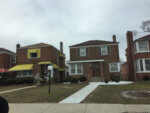
Hundreds of thousands of families moved into suburban homes in the 1970s.
Geese blocking road in the suburbs. Photo courtesy of Ray HananiaIt was much like the land grabs of the 1890s, except that in this modern land grab of the 1970s, the land wasn’t being given away. We were paying for it.
Oh, some may tell you how much they longed for the comfort and serenity of “suburbs.” It was the “American Dream.” Their dream. That’s what they’ll say.
They’ll even try to convince you about all the comforts they found in the suburbs during those early days of suburban settlement.
But did any of these families fleeing the terrible conditions of the city ever really stop to ask themselves why they were moving? Or, where they were going? We were running from, not running to, remember.
Well, if they had paused to think about it, or really know what they were getting into, they might have had second thoughts.
Take the name of where they were headed, for example.
“Suburb.”
The word “suburb” comes from the larger more accurate word, “suburban.”
And, the word “suburban” is a combination of two words that correctly depict the real circumstances of what these White Flight refugees really traded in when they left Chicago to settle in the suburbs.
“Sub-Urban.”
It might as well have been “sub-human.” Chicago was “urban.” So naturally, Suburban meant “less than the city.”
The idea of the “suburbs” had to have come from one of the Realtors who was busy trying to convince White People that they had to sell the homes they had spent years investing in at a below-market price. He knew what the word meant. “Sub-Urban.” “Sub-standard.” Most of the White people who moved to the suburbs in their rush to “get away” from something, were probably too ashamed to admit that maybe, just maybe, they may have made a mistake. By the time they realized that their suburban American Dream was in fact a nightmare, it was too late. They had traded in the “real, good life” for an empty promise that was more than 20 years away from becoming a reality.
We rushed out of our homes so fast that we haphazardly packed our belongings into cardboard boxes, unloading them when we arrived at our new homes. Most of the boxes were filled with years of accumulated possessions, so we didn’t mind leaving many of the boxes un-opened and stacked up in our news garages. It made sense to do that. The garages were attached to our homes, now, instead of across our backyards and opening into the alley.
And, there were so many boxes we couldn’t park our cars in the garage, anymore. Then we found ourselves in the unusual position of parking one of our most expensive possessions, our luxury car, in front of our house, while we stored all our junk in the secure garage.
Imagine the sales pitch that went a long with convincing a White homeowner to give up his city castle in exchange for the promise of the “sub-urban” unknown.
“Yes, it’s wonderful. And, instead of placing your garbage cans in the alley where the stink and unsightliness of the trash would be hidden from view, you will place all that on the front lawn. At the curb. Next to your new mailbox. Oh. I didn’t tell you that your mailbox was a metal little box on the top of a wood poll in your lawn in front of your house along the street? Where any Tom, Dick or Harry could drive by, reach in, and easily steal your Social Security check any time they want?”
But you can live with putting your trash in front of your house, because you quickly discover that you don’t have an alley. No alley? Whose insane idea of a joke was that, you ask helplessly as you open your first property tax bill and discover that while you have fewer city services, you have more land and your taxes have doubled!
With no alley to separate them, suburban backyards butt right up to each other. Many suburban homeowners still grow tall bushes along side of their backyard fences to create artificial barriers. Tall fences are expensive, but you soon discover that they are not good enough.
Our new “sub-urban” neighbor was a milkman who complained often that the milk delivery business had changed. Fewer and fewer people wanted their milk delivered to their homes and placed outside their front doors in the little zinc boxes, because a stranger might have access.
The garbage in placed in front of our homes?
The mailbox is at the curb?
If only those were the only problems.
“Oh, there are beautiful ponds filled with ducks and geese. They’re everywhere. Honking. Barking. Stirring up a storm.”
You give up the little bird droppings that spotted your car in the city, to half-pound white and green blobs from the ducks, that cover your car every time.
There are no trees, of course. The “sub-urban” “sub-division” that you live in doesn’t have any trees yet. It will take some 30 years before trees even start to grow, if you agreed in the beginning, when you bought your house, to also dish out more cash and buy the trees.
They weren’t there when you moved in. So you probably didn’t go out to buy any trees.
So, in the summer, your lawn burns to death, or you it with a special in-lawn sprinkler. And, your water bill goes up.
And that’s the kicker.
The water doesn’t come from one of those many ponds and small “lakes” they sold you on when you bought your home. It comes from Chicago, the place that you just left where your water was practically for free.
But Chicago doubles the price of the water it sells you and tosses in a surcharge on top.
And, you’re supposed to be happy with that, unless you don’t mind drinking water from a farm well that tastes like copper and smells like rotten eggs. Believe me, well water is gross.
You give up the well cared for streets of the city of Chicago.
How many times did you cuss and curse the street cleaners and snow plows in Chicago?
Now you are in Chicago wishing they were here doing a half-assed job of cleaning your streets, because in the small, new suburban municipality where you live can’t afford to provide the same kind of street service.
In the winter time, the snow fall just melts on the street and your car’s wheel squeals helplessly as you try to maneuver it out just so that you can drive back the extra 15 miles to your city job.
You discover they don’t plow the suburban streets as well as they did in Chicago.
That’s why they call it “sub-urban.”
When was the last time that you saw a street sweeper pass by your suburban home?
Of course, you also discover that without trees, and with the homes located so far apart, and with all that room for the wind to get its running start, the snowfall is heavier and more constant. And, you’ve spent twice as much money to buy winter clothes because it’s colder out there in the suburbs. And you have to buy a new shovel that loads up more snow, because your driveway and sidewalks are longer. During the winter, snow drifts buried driveways, cars, streets and dreams.
The city’s sewer system may smell, but it works. In the suburbs, your sewer systems are newer but not capable of handling the larger rainfalls that accumulate over prairie land. In the Spring, the water comes from the larger accumulations of melting snow. Flood waters cover your street and even flood your homes, because you don’t have a basement causing extensive damage because the suburban planning is poor and built right in areas designated as “flood plains.”
You left the city because you wanted safety. You wanted security. But the first thing you do when you moved into your new suburban home is to build a six foot high security fence. The fences in the city were short and you could reach over and shake your neighbors hands. You got to know your neighbor better in the city. In the new suburbs, you find yourself in a self-imposed isolation, sought maybe out of shame.
The property lots were larger. It also meant that people lived further away. That may contribute to the sensation that people in the suburbs remain distant from one another. You know who your next door neighbors are, but you often did not know who lived across the street. Even though you could see them every day, you never really got to know them.
That was it. Waving and saying hello is not “friendship.”
Maybe that’s why they call it a “sub-division.”
A screen door is no longer good enough. You have to have a “security door” with metal bars. You need it to add to the “safety” of the suburbs.
Suburban homes are surrounded by freshly laid concrete, wide asphalt streets, and unobstructed, open skies. While you freeze in the winter, it’s even worse in the summer. The un-shaded homes sizzle, forcing air conditioning units to full power and causing electrical outages.
In addition to shoveling more snow in the winter, these new “sub-urban” homeowners found themselves spending more money to care for their larger lawns. Mowing a lawn no longer became a chore. It became a weekend career. Suburban lawns required manicuring, trimming, laying sod, and weeding, and they thrived on regular sprinklings of tons of expensive fertilizers. The larger lawns meant we had more room to play in, but it also meant we had more grass to mow. The push mower instantly became obsolete and we had to go out and buy a gas-powered lawn mower.
And then there was the discrimination.
Wasn’t that a part of the reason why we left in the first place?
You discover that it exists out there, in the suburbs, too.
The first day we moved into our ranch home in “sub-urban” Burbank, I was somewhat awed. It was a very pretty home. Larger than what we had. I actually got my own bedroom for the first time in my life.
And then it happened.
A kid, who lived across the “non-alley,” cut through several backyards and stood by watching as we moved in. He kept yelling at me every time I would walk by: “Punjab. Punjab. Hey Punjab.”
I just assumed the kid was retarded and only knew one word. I didn’t even know what the word meant. It reminded me of the old Chicago neighborhood we left. And, the new family that had moved in with the retarded daughter. Or, like the time I was at Joseph Warren Elementary school and I had worn brand new socks with a black and gray colored geometric pattern. In class, I sat behind a girl, who didn’t think that much of me to begin with. But, when she turned around and looked down at my socks, she blurted out, somewhat indignantly, “those socks are pathetic.”
I was ecstatic.
I really liked her, even though I don’t think she really liked me much. I was a goofy kid. Still, I remember thinking, “She said I was ‘pathetic’,” believing it to be a compliment. When I finally looked up the word in the dictionary, I was sure I had spelled the word wrong. Anyway, I know that kids are kids and the fact was, she was right. Those socks with the weird patterns were “pathetic!”
Many years later, I figured out that “Punjab” was not a compliment either, or the retarded kid’s way of trying to get my attention to become friends. He meant it as an Indian or Pakistani term. Obviously, he thought our olive skin meant we were foreigners from that area. The kid was obviously making fun of the color of our skin.
People in the suburbs were about as happy to see us (being olive skinned Arabs) as we had been happy to see Blacks move into South Shore Valley, I guess.
Stories of this kind of treatment would often get to some of the families that remained in South Shore Valley, they and caused them to cheer. I had heard many stories just before we left the city about how others had fled only to discover that there were Black families out there too.
Midnight Flight
Chapter 3: A Beautiful, Idyllic Community
Chapter 4: Written Long Before
Chapter 6: Alone in the Playground
Chapter 8: In the Eye of the Storm
Chapter 10: The Sub-Urban Life
Chapter 11: Friends Left Behind
Chapter 13: Notes from Readers
Click here to subscribe FREE to Ray Hanania's Columns


His award winning columns can be found at www.HANANIA.COM Subscribe FREE today
Hanania also writes about Middle East issues for the Arab News, and The Arab Daily News criticizing government policies in the Israeli-Palestinian conflict.
Hanania was named "Best Ethnic American Columnist" by the New America Media in November 2007, and is the 2009 recipient of the SPJ National Sigma Delta Chi Award for column writing.
Email Ray Hanania at [email protected].
Follow RayHanania at Twitter
- Northfield Township Road District Approves 4.6% Levy Reduction, First Tax Cut in Three Decades - September 15, 2026
- Chicagoland pastors reiterate call to release religious leader detained in South Korea - September 15, 2026
- Ray Hanania on politics podcast: A great public servant, Maria Pappas - September 14, 2026