











Click here to subscribe FREE to Ray Hanania's Columns
Illinois Senator Committee approves resolution urging Illinois K through 12 schools to offer Arabic as Foreign Language option
By Ray Hanania
As Consolidated High School District 230, one of the largest in Illinois, blocked the adoption of Arabic as a Foreign Language at their three High Schools, Sandburg High School, Andrew High School, and Stagg High School, an Illinois State Senate Committee has taken the issue out of their hands and is pushing the option forward, statewide.
The resolution SJR0050 was approved by the Illinois Senate Education Committee by a unanimous 12 to 0 vote, with one member not voting because they were absent. It will now go before the full Senate for a vote.
The resolution was advanced by Senator Meg Loughran Cappel, sponsored by Senator Graciela Guzmán (20th Legislative District), with Senator Mike Porfirio as Chief Co-Sponsor.
The vote follows in the wake of the resignation of District 230’s only Arab American member, Mohammed Jaber, an education professional who cited constant opposition and hurdles by the District 230 administration and specifically by Board Chairman Lynn Zeder to his three-year campaign to get the Arabic Language added to the schools’ curriculum offering. The day before the State Senate vote, District 230 announced it had selected an Orland Park activist, Mo Hammad, to complete his term

Sponsors described the Education Committee’s adoption of SJR0050 as “a first step toward building the state-level Arabic language infrastructure, something that no other U.S. state has yet created.”
Jaber’s election on April 4, 2023, to the board ended more than 30 years of racism and oppositions by the district against anything “Arab.” Yet Jaber often found himself arguing in the face of overwhelming opposition on the District 230 board that the Arabic language option was primarily an asset to every student who might pursue a business career to exploit the huge opportunities that Arab World businesses currently offer to Americans and European nations.
When Jaber moved at a meeting in January 2026 to formally put the issue on the schools agenda to consider approving Arabic Language for District 230, all of the board members refused to second it. It failed because it did not receive a second. Board Chairperson Lynn Zeder was blamed by many for urging other board members not to second Jaber’s pre-announced motion, although other activists were also suspected of seeking to undermine Jaber’s efforts. The motion died without a second or a comment, and the language option was pushed to a future, uncertain date.
The resolution by the state ends all the obfuscation and interference against the proposal from District 230.
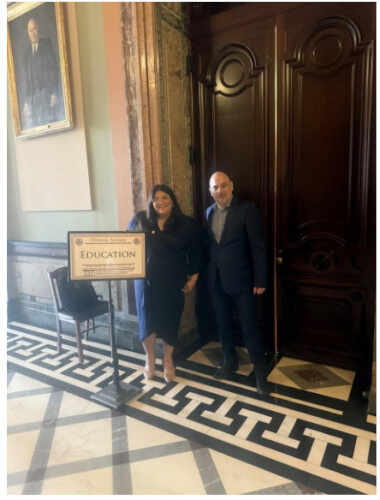
SJR0050 encourages school districts across Illinois to explore the introduction of Arabic as a foreign language option in their curricula, through transparent and collaborative processes that make full use of available state and federal resources. It is the first state-level legislative resolution of its kind in Illinois and is designed as a replicable model for adoption by other states.
Porfirio praised the Senate’s actions, saying, “The Arabic language is spoken by hundreds of millions of people around the world. By having school districts throughout Illinois to include Arabic as a foreign language option in their curriculum, we expand job opportunities for all Illinois students, support multilingualism, and prepare graduates to make an international impact.”
The Committee cited a Federally recognize Gap in Illinois Schools in failing to offer the Arabic language to students.
The federal government has designated Arabic a Critical Need Language since 2008, through a joint determination of the Secretaries of State, Education, and Defense and the Director of National Intelligence. Despite this designation, Arabic is among the most underrepresented languages in U.S. public education. According to the most recent national K–16 foreign language enrollment survey, only 161 U.S. high schools offered Arabic — compared to 8,178 offering Spanish — and fewer than 500 students in 5 Illinois high schools had access to Arabic instruction, representing less than 0.02 percent of the state’s 2.2 million K–12 students.

Arabic college enrollment fell by 27.4 percent between 2016 and 2021, compressing the future teacher pipeline. Government Accountability Office reports have repeatedly documented that the U.S. State Department faces a 37 percent Arabic proficiency shortfall in Near East language-designated positions, directly impairing visa adjudication, diplomatic communication, and national security operations.
SJR0050 addresses this gap by connecting Arabic instruction to federal Critical Language designations, the State Seal of Biliteracy, and existing Illinois multilingual education frameworks.
Federico Luque Macías, Ph.D., who had testified at a meeting of the High School District in January 2026, urging adoption of the Arabic Language option for the high school district, initiated the push to adopt SJR0050. Macias is an Arabic & Spanish Educator, Lincoln Park High School, CPS; Chicago Arabic Teachers Council Executive Committee Member; Area A Vice President, and a member of the Chicago Teachers Union.
“This resolution is the first legislative step toward giving Arabic the institutional foundation it has at the federal level but has never had at the state level. The federal government has been telling us for nearly two decades that Arabic is essential to our national security. Today, the Illinois Senate Education Committee agreed that Illinois should act on that. I am deeply grateful to Senator Guzmán for her leadership, to Senator Porfirio for his co-sponsorship, and to every member of the committee who voted yes,” Macxias said in a release issued by the Education Cmmittee members.
Macias was highly praised by Jaber as a primary source on adding the language. Macias’ recommendation was ignored by the District 230 board at the same meeting in January 2026 at which the board members refused to second a motion by Jaber to hold a formal discussion during that January meeting.
Senator Graciela Guzmán, 20th Legislative District, primary sponsor of SJR0050, said, “Arabic is spoken in the homes of hundreds of thousands of Illinois families. These students deserve the opportunity to develop and formalize their heritage language in our public schools — a language the federal government itself recognizes as critical to our national future. SJR0050 is a statement that Illinois is prepared to lead.”
Guzman said the path forward is clear now with the committee’s unanimous adoption. SJR0050 has been placed on the Calendar Order of Secretary’s Desk Resolutions for May 7, 2026, positioning it for an eventual full Senate floor vote.
If adopted by the full Senate, it will constitute the first Illinois legislative recognition of Arabic as a priority world language for K–12 public education, Guzman said.
The initiative is designed for multistate replication, following the trajectory of the State Seal of Biliteracy, which was enacted in California in 2011, adopted by Illinois in 2013, and subsequently recognized in all 50 states and the District of Columbia. Dr. Luque Macías and his coalition — including the Qatar Foundation International, the Chicago Arabic Teachers Council, the Illinois Federation of Teachers, and the Chicago Teachers Union — are actively engaged in parallel outreach with other states.
About the initiative
SJR0050 was initiated, drafted, and shepherded through the legislative process by Dr. Federico Luque Macías, a doctoral specialist in Arabic Philology (University of Seville, Ph.D. 2017, International Mention; research appointment at the University of Pennsylvania under Professor Roger Allen), an Arabic and Spanish educator at Lincoln Park High School in Chicago Public Schools since 2017, and Area A Vice President of the Chicago Teachers Union. He is among a very small number of educators in the United States who hold doctoral-level Arabic expertise and are actively teaching Arabic within the International Baccalaureate framework in a U.S. public school.
The initiative has the institutional support of the Qatar Foundation International, the Chicago Arabic Teachers Council (hosted at the Center for Middle Eastern Studies, University of Chicago, in partnership with Northwestern University and DePaul University), the Illinois Federation of Teachers, and the Chicago Teachers Union.
Click here to subscribe FREE to Ray Hanania's Columns


His award winning columns can be found at www.HANANIA.COM Subscribe FREE today
Hanania also writes about Middle East issues for the Arab News, and The Arab Daily News criticizing government policies in the Israeli-Palestinian conflict.
Hanania was named "Best Ethnic American Columnist" by the New America Media in November 2007, and is the 2009 recipient of the SPJ National Sigma Delta Chi Award for column writing.
Email Ray Hanania at [email protected].
Follow RayHanania at Twitter
- Paul Vallas Blasts Chicago Teachers Union, Questions Billionaire Influence in Mayoral Race During “Two Guys on Politics” Podcast - October 17, 2026
- Leving Rescued Dad’s Daughter from Reported Violent Home and Gave Her Hope - October 15, 2026
- Maria Pappas shares emotional stories of family, faith and perseverance during Romanian Heritage Center book signing - October 10, 2026