











Click here to subscribe FREE to Ray Hanania's Columns
Midnight Flight: Chapter 1, Introduction
By Ray Hanania
Midnight Flight, (C) 1990-2020 Ray Hanania, All Rights Reserved
This book is about one family’s experience of White Flight from a changing and great Chicago community, South Shore Valley (also called South Shore Gardens, Calumet Heights). It is also one person’s memory of living in a wonderful community and the many factors, from racial change to social evolution that occurred. It’s not perfect! But I have done my best to update it.
Some Facebook links for further info:
My Facebook Page — Go there?
Caldwell Elementary School (1966) — Go There?
Joseph Warren Elementary School (60s-71) — Go There?
Thomas Hoyne Elementary School (67) — Go There?
Henry Hart JCC (60s) — Go There?
Pill Hill facebook Group (60s) — Go there?
(Earhart and Warren Elementary and Bowen alums)
I Grew up South Shore Gardens Facebook Page
Bowen Class of 1968 50 Year Reunion August 2018. Click here
My family’s flight began in the Fall of 1968 through the Spring of 1969, at a time when racial tensions were peaking, not just in our neighborhood, but around the country as well. This book tries to trace that experience, but only depicts a slice of the larger human tragedy and trauma that has haunted Chicago for decades. It is not an analytical portrayal of the bigger, complex problem of racial divisions. Instead, Midnight Flight offers a perspective of an experience that was shared by many people who lived in South Shore Valley (some call it South Shore Gardens), a once all-White community that turned Black, practically overnight.
Why did things happen the way they did? What motivated homeowners to uproot themselves so hastily (and recklessly) and move?
Many of the White homeowners who moved, did so in the middle of the night. That alone says something about the factors that were at play, which I hope I have addressed. There is certainly a shame to be found in selling something you love just because you are afraid to live next door or down the street from a Black family. But behind that shame are good people and a community that remains one of Chicago’s best.
South Shore Valley (South Shore Gardens, also Calumet Heights) was south of South Shore, north of Jeffrey Manor (also spelled Jeffery) and east of Pill Hill where many wealthy doctors and their families lived. We sometimes jokingly referred to our area as “Bill Hill” because we paid the bills!
We left and ran away from something. We fled “from.” We didn’t run “to” something. We were told the place to run to was to “the suburbs,” which was considered unexplored wilderness just beyond the city’s limits. Years later, as the suburbs did develop and evolve socially, we tried to explain away our flight as being the natural desire to find something that we were told was important … the perfect “American Dream.” That is how many White homeowners came to describe the suburbs where many had fled.
But the suburbs we encountered, at that time and for many years to come, were far from being the American Dream others promised to us or that we convinced ourselves we had found. The experience of fleeing so hastily and blindly from a place we loved so much and that today remains a jewel among Chicago’s finest communities, remains an American Nightmare. The truth is that the suburbs we encountered in late 60s had not yet achieved the status that we had been promised. And today’s suburbs, 30 years later, are different. Developed. More civilized, yet still wanting. We’ve come to accept the changes of suburban-life that were thrust upon us in our mad rush to uproot. It’s strange how the suburbs still revolve around events in Chicago — probably because the news media is based in and focused on Chicago.
All this occurred during troubled American times. The events of the late 50s and 60s, not just those involving race, contributed toward the conditioning of society to be less trusting. Society began to expect the worst from others. To begin to “fear” things rather than have faith in what was good. That may be a bigger issue or trend that can be explored. But certainly, events during those years created a blanket of tension that fed White Flight.
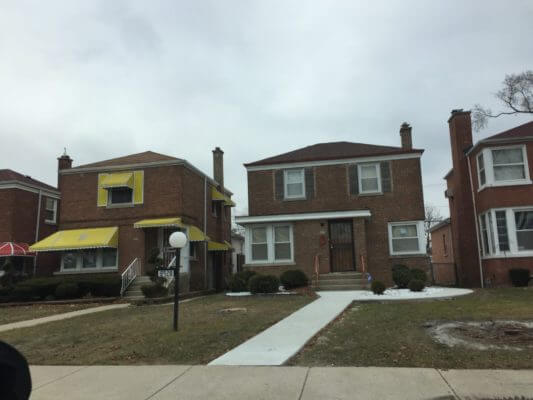
This eBook is not about justifying what happened, but looking at the circumstances of what happened. Prior to the migration of Blacks, diversity, discrimination and much more already existed in South Shore Valley. It was swept under the carpet and whispered behind closed doors. Asians. Arabs. Jews. Christians. South Shore Valley had a significant Jewish population, but there were many others who lived there, too. We all had differences, but we were living together under a de facto tolerance of those differences for the sake of a community that we all cherished. That is the amazing achievement that is sometimes forgotten by people who look back.
South Shore Valley has come to symbolize White Flight and Realtor-orchestrated panic-peddling in its most open and flagrant form, resulting in block-busting. Yet in the scheme of things, the role that South Shore Valley played in the Chicago area’s changing racial patterns has not been acknowledged, and, consequently, the factors that came into play have not been fully addressed.
Oftentimes, White Flight is brushed off as simply the result of racism and racial tensions, when the reality is the problem is much more complex.
One recent effort to examine the transformation of this area is called The South Side authored by neighbor and classmate, Louis Rosen. Rosen approached the transformation of South Shore Valley from a unique perspective exploring in narrated interviews the relations that existed between the area’s large Jewish community and the Black community that settled there. Offering personal insights into the changes that occurred are an assortment of former residents and Black families. The interviews were conducted over a two year period beginning in 1994.
Another great book is by Caryn Lazar Amster called The Pied Piper of South Shore, Toys and Tragedy in Chicago which recounts her family’s experience and their personal tragedy. Her website is www.chicagospiedpiper.com.
Despite the excellent efforts of Louis Rosen and myself, the story of the transformation of South Shore Valley remains little more than a footnote, or a passing entry, in a larger profile of the city. It is missing the significance of the community nuances of the mixing of on-going social, racial and physical transformation. In fact, when people look back at that region, they never look back far enough to the 1960s. It’s almost as if we didn’t exist.
Homeowners were not only pressured to leave by Realtors, their flight was accommodated. The role of the Realtors went far beyond helping to de-value your home and re-sell it at a below-market price. It also involved their conspiring to help the targeted families to land temporary rental homes, since many had not yet found new homes. Realtors even went to great extent to help them register their kids in schools when the temporary homes they rented were outside of a preferred White School district and was located instead in a school district that was all or predominantly Black.
“Don’t worry about where you are going. Worry about leaving where you are at.” That was the clear message, and even the strongest in the community who helped to instill calm and reason among the neighbors, succumbed and eventually fled.
My family, and many other families, found itself in the center of a social cataclysm that would set the stage for molding the future of race relations in the Chicago region.
Everything happened so quickly. It happened suddenly. We were told that “Black people” were moving in, and we ran. Most of us did not know “Black people” the way we knew other ethnic minorities or racial groups. We were willing to accept the worst stereotypes about them without question.
South Shore Valley was a very tightly knit community, a mosaic of ethnic groups whose fingers seemed to touch each other respectfully. Jews and Arabs, for example, lived among each other. We were all friends. In the backdrop was a music revolution that had a direct impact on shaping the attitudes and the mind-set of society that extended far beyond the 1960s. It reached out to the heart of their emotions.
You can’t look at this period without touching upon the songs and music that filled the radio airwaves and influenced our lives very directly.
It is unfair to single South Shore Valley out with regards to the issues of racial strife and White Flight. It was merely a part of a bigger problem that swept throughout the city and the country. Racial change and tensions erupted throughout Chicago where Black and White culture made contact. But our story is one that justifies special attention and review.
The story is tragic, in ways. Our flight was irrational. Unjustified. And it was even shameful, for some. Everyone played a role in that shame and it doesn’t solely rest on the shoulders of one family. Still, it was a beautiful community and the friends I made there have remained in my memories for life.
That was more than 30 years ago. Certainly these are different times. There is greater understanding, and more tolerance of others. But, it is time that we carefully look back at what happened, maybe to insure that it doesn’t happen again.
I hope this book adds to the perspective of what happened, and allows those who lived there and still do to share their views and experiences.
(Sorry if my memory is not 100 percent. This remembrance was written many years after. I’m always happy to make corrections to get the record right. So email me at [email protected].
(NOTE: There is some use of harsh words like “nigger” that had to be included to properly reflect the atmosphere that existed in Chicago in 1968. It’s an ugly word with an ugly meaning, but that’s part of what this story is all about.)
— Ray Hanania
Midnight Flight
Chapter 3: A Beautiful, Idyllic Community
Chapter 4: Written Long Before
Chapter 6: Alone in the Playground
Chapter 8: In the Eye of the Storm
Chapter 10: The Sub-Urban Life
Chapter 11: Friends Left Behind
Chapter 13: Notes from Readers
Click here to subscribe FREE to Ray Hanania's Columns


His award winning columns can be found at www.HANANIA.COM Subscribe FREE today
Hanania also writes about Middle East issues for the Arab News, and The Arab Daily News criticizing government policies in the Israeli-Palestinian conflict.
Hanania was named "Best Ethnic American Columnist" by the New America Media in November 2007, and is the 2009 recipient of the SPJ National Sigma Delta Chi Award for column writing.
Email Ray Hanania at [email protected].
Follow RayHanania at Twitter