








Click here to subscribe FREE to Ray Hanania's Columns
Midnight Flight: Chapter 9 — Midnight Flight
One family’s experience of White Flight and the racial transformation of Chicago’s South Side (an online novel)
By Ray Hanania
Midnight Flight, (C) 1990-2018 Ray Hanania, All Rights Reserved
“I’m gonna leave the city, got to get away.
“I’m gonna leave the city, got to get away.
“All this fussing and fighting, man,
“You know I sure can’t stay.”
— Going Up the Country, Canned Heat, 1969
“There is a community meeting tonight at Stuart’s home, across the street,” my father told my mother.
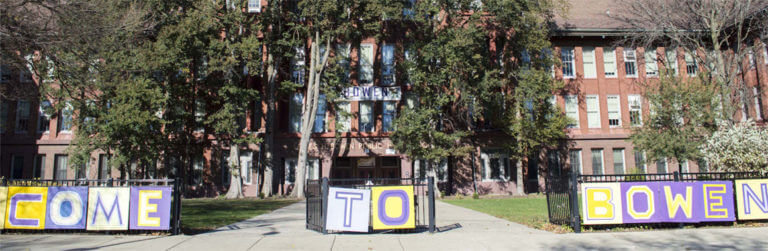
It was the end of the summer of 1968 and I was preparing to return to Bowen High school as a sophomore. My sister, Linda, was just enrolling there for the first time as a Freshman. And my brother, John, had already left to return to college at the Michigan Institute of Technology where he studied engineering and played on the school hockey team. John had graduated from CVS. I still have the 8 mm film of his graduation from CVS held at another outdoor stadium on Chicago’s North Side.
Most of the older kids in the neighborhood had also gone to college. Jeff Pomerantz, whose father owned a haberdashery, was in college, as were Ron Smerek and Frank Zurek.
My friends and I were the older generation now, and we were alert to the fact that something disruptive was happening. It was the talk of the neighborhood. Racial change. No one ever took the time to define it for anyone. Everyone was left to react in their own way, or to follow the “herd” which reacted in the most negative ways.
I was with a friend and his mother was driving us someplace in their car. I don’t recall where we were going. But he had said to me that he heard some “Schvartzes” had moved into the area near Stony Island Avenue. Schvartz was the common Yiddish word for Black people that many in the Jewish community preferred to words like “Colored,” Black or even “nigger.” Some of the Christian kids were also calling the Black students Schvartz, too. One of them asked me what it meant, saying he thought it meant something worse than “nigger,” which was his intent.
Race was a major issue in Chicago in the 1960s, whether we meant it to be or not.
The fact that Blacks were moving into the area wasn’t really news, although we hadn’t experienced a family moving near us or on our blocks, yet. But then he said that some of the people were saying the Black families were also buying homes in places like Flossmor and also Niles and Skokie. That prompted his mother to exclaim somewhat startled, “I hope the Schvartzes aren’t moving to Niles. That’s where we’re going.”
The Jewish families were much more organized than the rest of us. And they were organized closely around their religion.
While we went to Bethany Lutheran Church for Sunday worship, summer Bible school and even a few dances and summer picnics, the Jewish community’s organization was much more intense.
For them, Synagogue Rodfei Shalom was more than just a place of worship. It was the center of Jewish community life and activity. More than 800 Jewish families were members of the Congregation, making it one of the largest community organizations on the Southwest Side. Some 1,800 students went to the Hebrew School there, too. They were also all members of The Henry Hart Jewish Community Center, located across the street on Jeffery with its new outdoor swimming pool, drew large attendance that summer.
In fact, it was such a part of their life that my friends often brought me to Hebrew school with them.
Naturally, the Jewish community is where most of the organizing in response to the threats of block-busting first began.
Fathers met at the Synagogue and formed “Stop Move” committees. These committees were distributed throughout South Shore Valley and even in Jeffery Manor. There was a school in Jeffery Manor just east of Luella Avenue called Luella Elementary, 9928 S. Cranston, which also was undergoing a racial change in its student body. That school also served Merrionette Manor.
A Jewish family on our block in a house across the street from us was in charge of one of the committees that tried to “bring our area together.”
I wasn’t permitted to attend the meetings — actually I don’t think I would have been interested — but dad would return and relate to mom what had happened. And I would listen.
All I knew was that the discussions had to do with “Colored” people moving into “our” neighborhood. My dad referred to the Black people as “Abeed,” which means “Black” in Arabic.
“They said the Abeed have already crossed Stony Island,” dad said.
“What about the Hitching Post restaurant? Can we still go there to have dinner?” Mom asked startled by the revelation that somehow Black people crossing into Stony Island Avenue also meant we would no longer be able to frequent popular restaurants. “What about shopping there?”
It was as if they were talking about enemy armies that had captured a strategic location. The Hitching Post, for many years, was a very popular restaurant. I hadn’t realized it was a military outpost, too. (Today, it is renamed “The Queen of the Sea” restaurant.)
The organizers of the meeting had all agreed that they would not permit anyone to place “For Sale” signs on their front lawns, although legally, there was little they could do to stop anyone.
But talk was cheap, and at first, it seemed to be effective.
Some of the homeowners even drew large signs on “construction paper” that they put up in their homes on their windows that read “Not for Sale.”
None of the homes that were sold had placed “For Sale” signs on their lawns. Not even the organizer of the meetings on our block had placed a “For Sale” sign on his lawn. He sold his house within a month of organizing the meetings and moved his family and furniture early in the wee hours of the morning.
His departure was discouraging to many of the people who thought the “Stop Move” movement was beneficial. It took weeks before another meeting was called.
Once his house was sold, everyone’s houses were being sold, too. Homes changed hands quickly. Black families were moving in at a rapid pace and White homeowners couldn’t sell their homes fast enough.
Ironically, while all this was happening, some Realtors were prepared to make money off of anyone, selling the home across the alley from us on Paxton Avenue to a White family. The family went into near shock when they realized they had purchased a “below market priced home” in a neighborhood that was changing racially.
I remember meeting the lady who moved in. I was taking out the garbage and was lifting the metal door to the cement garbage container next to our garage when the lady called to me.
“Your family isn’t moving. Are you?” she asked surprised.
I shrugged my shoulders. I honestly didn’t know if we were moving out or not. “I don’t know,” I said.
“This is unbelievable. We just moved in. Why is everyone leaving? This is a beautiful neighborhood. If no one moves out it will stay that way,” she told me. I don’t know if she was talking to me, as much as just venting her frustrations.
I think later that week, she came by and introduced herself to my mother, and I think they had the same conversation.
It didn’t do any good, though.
It was like that everywhere.
When I returned to Bowen High school that fall, there were more Black students registered at the school and there were frequent gang fights between Black and Hispanic students. The Spanish Kings were really up in arms, painting street gang symbols insulting Black gangs, and vice versa. The increase in Black and Hispanic gang violence at the school only fed the stereotype and the growing fears of Whites in the area.
One day, there was a shooting in the lunchroom. That was bringing it real close to home, so to speak.
Because although it happened at school, the stories came back to the homes with the kids, who described in vivid detail how the shooting took place. It was horrific.
We walked to Bowen High school. And while we were used to the distance, having walked to Warren Elementary school every day of our lives, it was somewhat scarier. We would have to walk through the Skyway viaduct to cross into the East Side from our neighborhood into Bessemer Park near the high school.
Every week, the gang signs painted on the walls of the viaduct would change. One time, as we walked to school, Black and Hispanic gangs were slugging it out right at the entrance near the park.
We’d come home and watch television news reports of the violence occurring around us, and we would listen to the discouraging reports about the rising death toll in Vietnam.
I don’t know which was worse. Watching the violence at school or seeing it in living color in the comforts of our homes. Two wars. Two battles. Two conflicts. It seemed as if the dividing line between what was happening in Vietnam and what was happening in our backgrounds did not exist, and emotions and perceptions were being confused.
Protesting the Vietnam War was one way that we could vent our frustrations, I guess.
I had joined up with a group of students that drove downtown and participated in an anti-war march down State Street, ending up at a rally at a large auditorium or hall. There seemed to be a sense of togetherness. White students. Black students. Hispanic students. We were all together protesting against something, rather than against each other.
It was only a temporary escape from the reality of the anger and hatred that seemed to swell all around us.
Those days of fun at Warren Elementary school were long gone, erased by the seeming violence that was erupting all around us. Bowen High school was no fun either.
I guess when my father broke the news to us that we were moving, maybe I felt a little relieved.
“Where we gonna go, dad?” I asked.
“Someplace where we can get away from all these problems.”
And, the “Abeed,” of course.
Midnight Flight
Chapter 3: A Beautiful, Idyllic Community
Chapter 4: Written Long Before
Chapter 6: Alone in the Playground
Chapter 8: In the Eye of the Storm
Chapter 10: The Sub-Urban Life
Chapter 11: Friends Left Behind
Chapter 13: Notes from Readers
Click here to subscribe FREE to Ray Hanania's Columns


His award winning columns can be found at www.HANANIA.COM Subscribe FREE today
Hanania also writes about Middle East issues for the Arab News, and The Arab Daily News criticizing government policies in the Israeli-Palestinian conflict.
Hanania was named "Best Ethnic American Columnist" by the New America Media in November 2007, and is the 2009 recipient of the SPJ National Sigma Delta Chi Award for column writing.
Email Ray Hanania at [email protected].
Follow RayHanania at Twitter
- Southside Playoff Pep Rally and Baseball Costume Contest at Wintrust Sports Complex in Bedford Park Tuesday - October 4, 2026
- Bedford Park launches programs to separate sewer and water pipes to address flooding concerns - October 3, 2026
- Former CEO of Illinois Railcar Management Company Charged With Embezzling More Than $22 Million - October 1, 2026